

Blog
What a Tunnel Oven for Sublimation Mugs Really Does

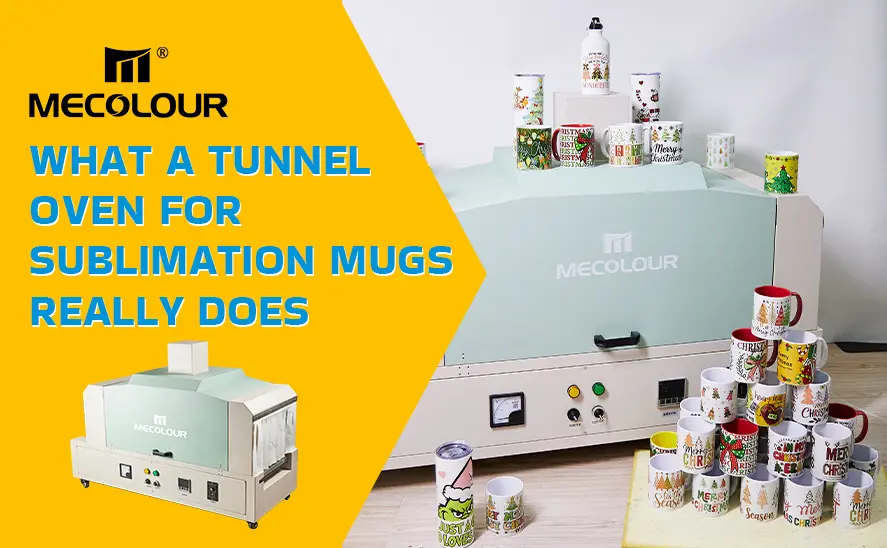
In professional mug printing, process stability, color accuracy, and production efficiency determine profitability. As demand for personalized sublimation mugs grows, manual and semi-automatic curing methods increasingly become bottlenecks. This is where the tunnel oven for sublimation mugs proves its value. We examine how tunnel ovens function, the technical principles behind continuous curing, and why they are rapidly becoming essential equipment for scalable mug sublimation operations.
The Core Function of a Tunnel Oven for Sublimation Mugs
A tunnel oven for sublimation mugs is an industrial heating system designed to cure sublimation transfers through controlled, continuous heat exposure. Unlike traditional mug presses that apply pressure and heat to one mug at a time, tunnel ovens use a conveyor-based heating chamber to process multiple mugs sequentially with consistent temperature distribution.
The oven maintains a precisely regulated thermal environment, typically between 180°C and 200°C, ensuring the sublimation ink transitions directly from solid to gas and permanently bonds with the polyester coating of the mug surface. This controlled process eliminates heat spikes, uneven curing, and manual timing errors that frequently cause ghosting or color shifts.
How the Conveyor Heating System Ensures Consistent Results
At the heart of a tunnel oven is its motorized conveyor belt. Each mug enters the tunnel at a fixed speed, passing through defined heating zones that gradually raise and maintain the required sublimation temperature.
Key technical advantages include:
- Uniform dwell time for every mug
- Even heat circulation via forced-air or infrared heating elements
- Reduced thermal shock, preserving mug coatings
- Repeatable curing profiles across production runs
By eliminating manual intervention, tunnel ovens remove variability caused by operator fatigue or inconsistent press timing. The result is predictable, repeatable output—a critical requirement for commercial-scale sublimation businesses.
Why Tunnel Ovens Improve Color Saturation and Image Sharpness
Sublimation quality is highly sensitive to temperature stability and exposure duration. Tunnel ovens excel because they maintain a constant thermal environment from entry to exit.
This stability directly impacts:
- Ink gasification completeness
- Color vibrancy and density
- Edge sharpness of text and graphics
- Reduction of faded or under-pressed areas
Because each mug receives the same thermal treatment, color variation between batches is minimized. This is especially important for branded orders where color consistency across hundreds or thousands of mugs is non-negotiable.
Labor Reduction and Workflow Optimization
Manual mug presses require continuous loading, unloading, pressure adjustment, and monitoring. Tunnel ovens transform this labor-intensive process into a streamlined production line.
Operational benefits include:
- One operator can manage dozens of mugs simultaneously
- No need for pressure calibration per mug
- Reduced training requirements for staff
- Lower physical strain and repetitive motion risk
By shifting labor from manual pressing to material handling, businesses significantly lower labor costs per unit while increasing daily output.
Scaling Production Without Increasing Reject Rates
As sublimation operations scale, quality control becomes harder to maintain. Manual processes often see higher rejection rates as speed increases. Tunnel ovens solve this by decoupling production speed from quality risk.
Because curing conditions remain constant regardless of volume, tunnel ovens enable:
- High-throughput production without quality degradation
- Lower scrap rates due to under- or over-heating
- Better yield predictability for large orders
This makes tunnel ovens particularly valuable for B2B suppliers, promotional product manufacturers, and fulfillment centers handling bulk mug orders.
Who Should Use a Tunnel Oven for Sublimation Mugs
Tunnel ovens are not limited to large factories. They provide clear advantages for multiple business types:
- Professional print shops handling daily mug orders
- E-commerce fulfillment operations with recurring SKUs
- Corporate gift manufacturers requiring consistent branding
- Distributors supplying white-label sublimation mugs
If daily output exceeds manual press capacity or consistency issues appear in batch production, a tunnel oven becomes a strategic investment rather than a luxury.
Production Problems Solved by Tunnel Ovens
Tunnel ovens directly address the most common sublimation mug challenges:
- Uneven color transfer
- Inconsistent heating across mug surfaces
- Operator-dependent quality variation
- Limited daily production capacity
- High rejection and rework rates
By standardizing the curing stage, tunnel ovens remove these variables and stabilize the entire sublimation workflow.
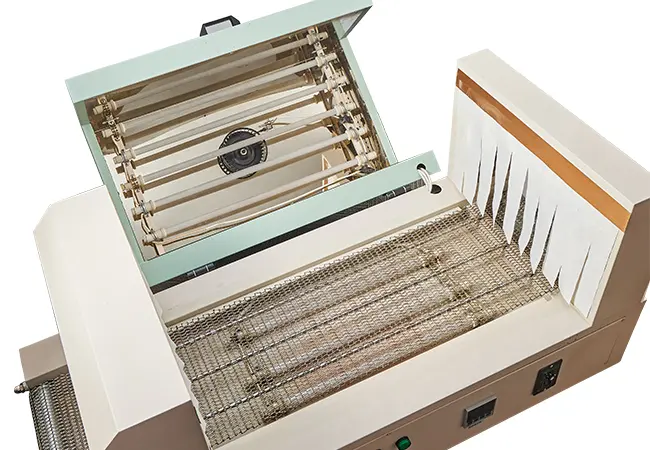
tunnel oven for mugs
Energy Efficiency and Cost Control
Modern tunnel ovens are designed with thermal insulation, zoned heating, and intelligent controllers that optimize energy usage. While they consume more power than a single mug press, the energy cost per mug is significantly lower due to high throughput.
Key efficiency factors include:
- Continuous operation without reheating cycles
- Reduced idle time between mugs
- Lower waste from rejected products
Over time, these efficiencies translate into lower operating costs and higher profit margins.
Long-Term Reliability and Maintenance Advantages
Compared to mechanical presses with moving pressure components, tunnel ovens have fewer wear points. Routine maintenance typically involves:
- Cleaning airflow filters
- Inspecting heating elements
- Conveyor belt alignment checks
This results in lower downtime and longer equipment lifespan, critical for high-volume operations.
Why Tunnel Ovens Matter for the Future of Mug Sublimation
As customization demand grows and delivery timelines shorten, sublimation businesses must balance speed, quality, and cost. Tunnel ovens address all three simultaneously. They enable consistent curing, scalable output, and predictable results—qualities that define competitive operations in modern print markets.
Investing in a tunnel oven is not simply about increasing speed; it is about process control, brand consistency, and operational resilience. For businesses seeking stable results, fewer rejected mugs, and scalable growth, tunnel ovens represent a foundational technology rather than an optional upgrade.
Related:
How to Sublimate Tumblers in an Oven?
Comparison: Sublimation Oven vs. Heat Press