

Blog
How DTF Ovens Improve Production Efficiency

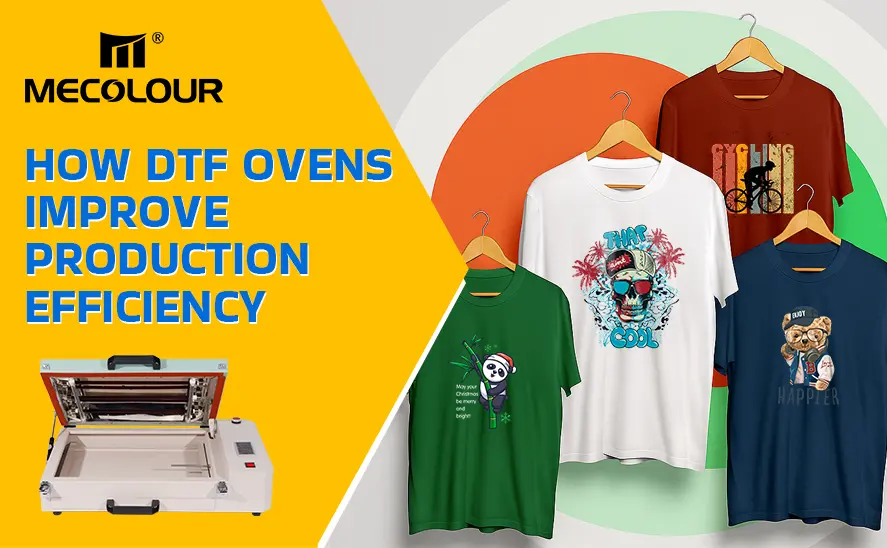
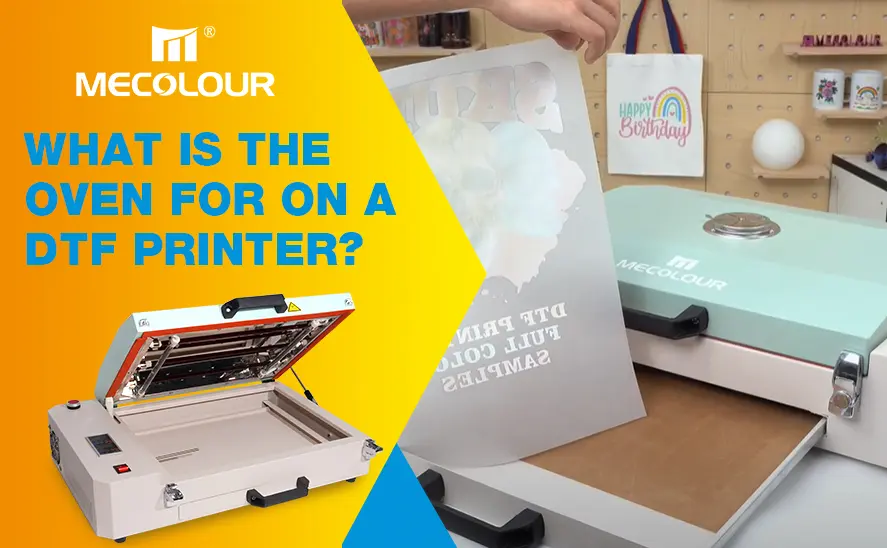
The rapid growth of Direct-to-Film printing has transformed the custom apparel industry. From small print shops to large-scale garment factories, businesses are investing in faster and more reliable DTF workflows to meet increasing market demand. While printers and heat presses often receive the most attention, the DTF ovens improve overall production efficiency and have become one of the most important pieces of equipment.
As a professional DTF oven manufacturer, we understand that curing quality directly affects transfer durability, workflow speed, print consistency, and operating costs. A high-performance DTF oven is not simply a heating device — it is the core system that stabilizes the entire DTF production process.
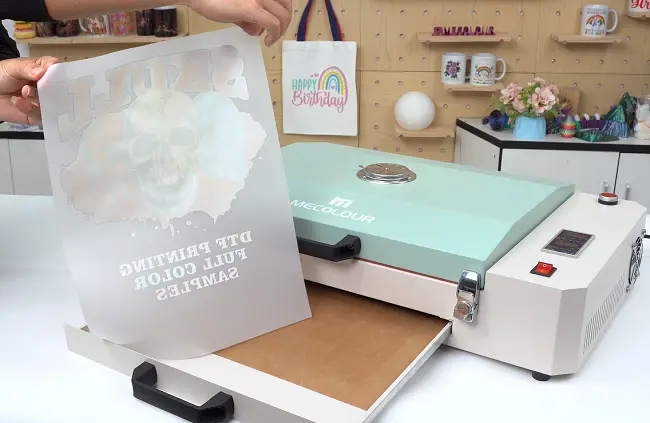
Why Efficient Powder Curing Matters in DTF Printing
In DTF production, curing quality determines whether the transfer will perform correctly during heat pressing and washing.
Poor curing may cause:
- Powder under-melting
- Transfer peeling
- Cracking after washing
- Weak adhesion
- Uneven texture
- Color fading
Many DTF production issues are directly related to inconsistent curing temperatures or uneven heat zones. Community discussions among print shops frequently identify under-cured powder as a major cause of transfer failure.
A professional DTF oven minimizes these risks through stable temperature control and even heating performance.
How DTF Ovens Increase Production Efficiency
1. Faster Curing Speeds
Traditional manual curing methods often require excessive waiting time and inconsistent heating. Modern DTF ovens use optimized heating systems to accelerate curing while maintaining stable results.
High-efficiency DTF ovens provide:
- Rapid temperature rise
- Faster powder melting
- Reduced waiting time
- Continuous workflow operation
Some modern A3 DTF ovens can reach working temperature within minutes while supporting continuous batch curing.
Faster curing directly improves production capacity, especially for businesses handling high daily transfer volumes.
2. Uniform Heat Distribution
Uneven heating is one of the biggest problems in low-quality curing systems. Cold spots can cause incomplete powder melting, while overheating may damage transfers.
Professional DTF ovens use:
- Multi-directional heating
- Balanced heating plates
- Scientific chamber design
- Full-width heat coverage
Advanced DTF ovens are engineered to eliminate dead zones and maintain consistent curing across the entire PET film surface.
Uniform curing improves transfer consistency and reduces production waste.
3. Reduced Transfer Failure Rates
Failed transfers increase:
- Material waste
- Labor costs
- Production delays
- Customer complaints
A high-quality DTF oven reduces failure rates by stabilizing curing conditions.
Reliable curing helps prevent:
- Powder contamination
- Edge lifting
- Poor adhesion
- Inconsistent texture
- Cracking during washing
Stable curing environments improve overall transfer reliability, especially for commercial production environments.
4. Improved Workflow Automation
Modern DTF ovens include intelligent control systems that simplify operation.
Common features include:
- Digital temperature display
- Automatic timers
- Alarm systems
- Adjustable heating settings
- Automatic shutdown functions
Many ovens now use built-in timers and buzzer alerts to notify operators when curing is complete.
Automation reduces manual monitoring and allows operators to focus on other production tasks.
5. Better Production Consistency
Consistency is critical for apparel businesses producing repeat orders.
Professional DTF ovens maintain:
- Stable curing temperature
- Repeatable results
- Controlled heating cycles
- Uniform transfer quality
Consistent curing ensures that every transfer maintains the same:
- Adhesion strength
- Stretch performance
- Color appearance
- Surface texture
This improves customer satisfaction while reducing costly reprints.
6. Lower Energy Consumption
Modern DTF ovens are engineered for energy-efficient operation.
Efficient heating systems reduce:
- Electricity usage
- Heat loss
- Idle energy waste
Energy-saving designs are especially important for businesses operating multiple printers and curing systems simultaneously.
Manufacturers increasingly focus on balancing heating performance with lower operating costs.
7. Safer Working Environment
Safety and operator comfort are important in high-volume production environments.
Professional DTF ovens improve workplace conditions through:
- Insulated handles
- Controlled heat systems
- Smoke vents
- Reduced odor exposure
- Stable chamber temperatures
Some upgraded DTF ovens include smoke ventilation systems and cooling fans to reduce fumes and improve work environments.
Better environmental control increases operator efficiency and workplace safety.
How DTF Ovens Support Small Business Growth
Small businesses and startup apparel brands often begin with limited production equipment. A compact A3 DTF oven provides an affordable way to increase production capacity without requiring large industrial systems.
Benefits for small businesses include:
- Compact desktop design
- Easy installation
- Low maintenance
- Fast learning curve
- Stable commercial-quality output
Desktop DTF ovens are especially popular for:
- Custom T-shirt shops
- Etsy businesses
- Promotional product companies
- Small print studios
- Local apparel brands
Compact A3 curing ovens allow businesses to scale production efficiently while maintaining professional-quality results.
DTF Oven Features That Improve Efficiency
Digital Temperature Control
Accurate temperature adjustment is essential for proper powder curing.
Digital controls allow operators to:
- Set exact temperatures
- Reduce overheating
- Improve repeatability
- Prevent curing inconsistencies
Timer and Alarm Functions
Timers improve production speed by standardizing curing cycles.
Automatic alerts help operators:
- Avoid over-curing
- Reduce monitoring time
- Increase multitasking efficiency
Pull-Out Tray Design
Many A3 ovens include pull-out trays for safer and faster operation.
Benefits include:
- Easier film loading
- Better operator safety
- Faster workflow movement
Multi-Lamp Heating Systems
Some DTF ovens use multiple heating lamps to improve heat consistency across the curing area. Multi-lamp systems help distribute heat more evenly and accelerate curing performance.
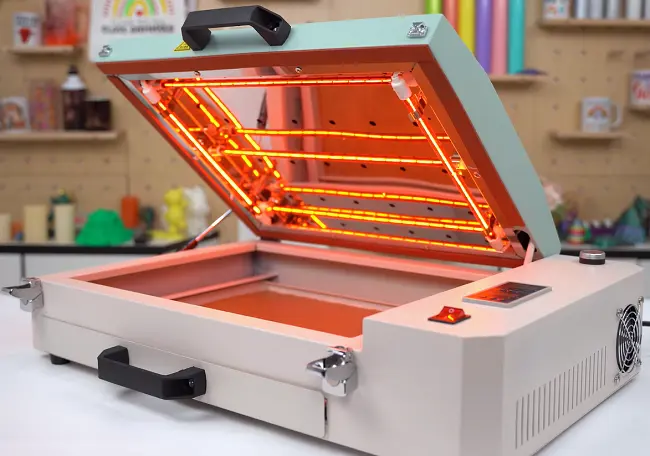
dtf oven Even heat distribution
Common Production Problems Solved by DTF Ovens
Uneven Powder Melting
Professional ovens eliminate inconsistent heating zones.
Slow Production Speed
Rapid heating systems improve workflow efficiency.
Transfer Peeling
Stable curing improves adhesive bonding strength.
Color Inconsistency
Balanced heat distribution protects print quality.
High Waste Rates
Controlled curing reduces failed transfers and material waste.
Why Professional Print Shops Choose Dedicated DTF Ovens
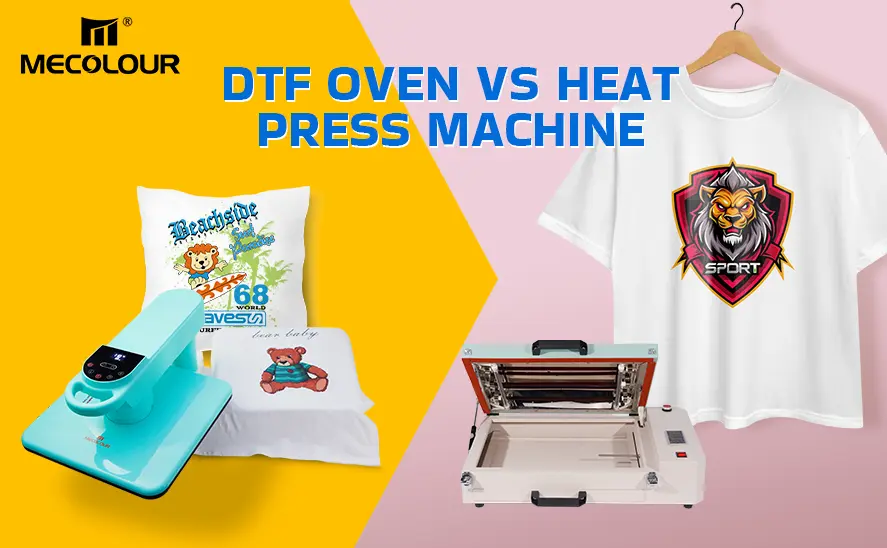
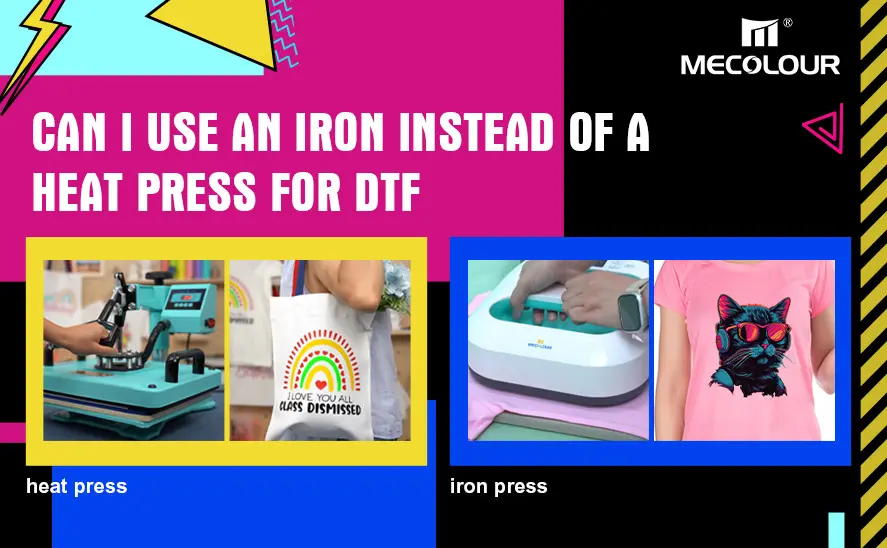
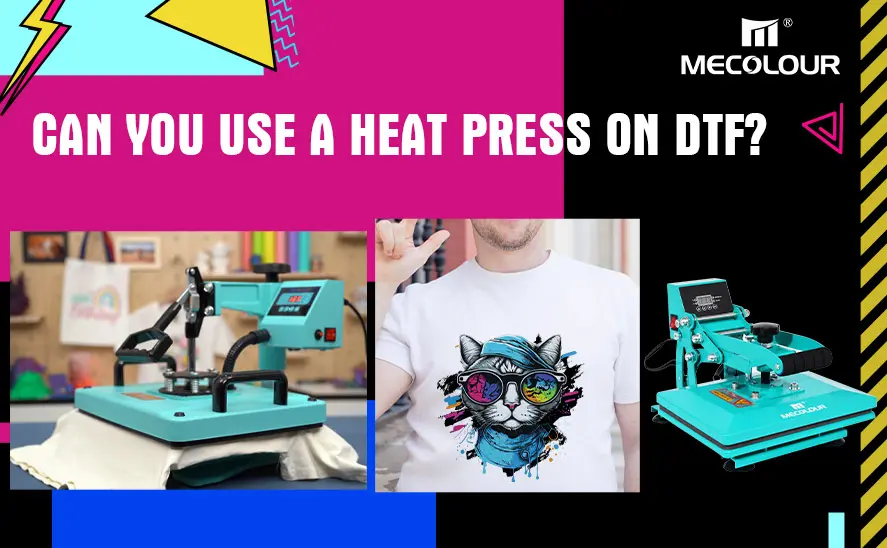
Some businesses initially attempt manual curing methods using heat presses or improvised heating systems. However, dedicated DTF ovens provide significant advantages:
| Feature | DTF Oven | Manual Curing |
|---|---|---|
| Heat Consistency | Excellent | Inconsistent |
| Workflow Speed | Fast | Slower |
| Batch Production | Efficient | Limited |
| Automation | Yes | Minimal |
| Safety | Higher | Lower |
| Production Stability | Reliable | Variable |
Dedicated DTF ovens improve scalability and support professional commercial production.
Choosing the Right DTF Oven
When selecting a DTF oven, businesses should evaluate:
- Heating consistency
- Temperature control accuracy
- Oven size compatibility
- Production capacity
- Energy efficiency
- Safety features
- Maintenance requirements
A3 DTF ovens are ideal for small and medium-sized apparel production because they balance compact size with efficient commercial output.
Why Businesses Choose Mecolour DTF Ovens
As a professional DTF equipment manufacturer, we design DTF ovens specifically for stable production performance and commercial efficiency.
Our DTF ovens provide:
- Uniform heat distribution
- Rapid heating systems
- Precise temperature control
- Compact desktop structure
- A3 and A4 film compatibility
- Reliable curing consistency
- User-friendly operation
- Durable industrial construction
Our goal is to help garment printing businesses reduce waste, improve transfer quality, and increase production efficiency through reliable DTF curing technology.
DTF ovens have become an essential component of efficient garment printing workflows. By improving curing speed, temperature consistency, production stability, and automation, modern DTF ovens help businesses produce higher-quality transfers with fewer errors and lower operating costs.
Whether for small custom apparel startups or high-volume commercial print shops, professional DTF ovens improve workflow efficiency while supporting consistent transfer quality and long-term business growth.
Related:
What Is a DTF Oven For?
Best DTF Ovens for Beginners: Simple and Affordable Picks
A3 DTF Oven Setup & Use Guide
DTF Oven vs Heat Press Machine