


Blog
Laminating Machine Specifications Explained: A B2B Guide


When comparing laminating machines, buyers often focus on price and appearance. However, technical specifications have a greater influence on whether a machine can handle the materials and production requirements of its intended users.
Four important specifications are laminating speed, working width, film thickness compatibility, and heating system. Understanding these parameters helps importers, distributors, and commercial buyers compare equipment more accurately.
1. Laminating Speed: What Does It Mean?
Laminating speed describes how quickly material passes through a machine, usually measured in millimeters per minute (mm/min) or meters per minute (m/min).
For example, a machine rated at 600 mm/min has a theoretical feeding speed of 0.6 meters per minute.
However, this does not mean every document will be completed in the same amount of time. Actual productivity also depends on warm-up time, material preparation, feeding intervals, and operator handling.
How to Evaluate Laminating Speed
For commercial buyers, it is useful to distinguish between:
-
Rated speed: The feeding speed specified by the manufacturer.
-
Warm-up time: The time required before the machine is ready for thermal lamination.
-
Actual throughput: The number of finished documents or prints produced within a given period.
A machine with a higher rated speed does not necessarily deliver higher productivity if frequent adjustments or manual handling are required.
For distributors, speed should be evaluated according to the expected workload of the target customers rather than treated as an isolated selling point.
2. Working Width: Why Is It Important?
Working width refers to the maximum width of material that a laminating machine can process.
It determines which document sizes and printed materials are compatible with the equipment.
Standard paper dimensions include:
| Paper Format | Dimensions |
|---|---|
| A4 | 210 × 297 mm |
| A3 | 297 × 420 mm |
The machine’s actual laminating opening must accommodate the document and its laminating film. Therefore, buyers should not assume that the nominal paper size is identical to the machine’s usable working width.
Choosing the Appropriate Working Width
Compact laminators are commonly used for office documents, photographs, and certificates.
For larger documents and printed graphics, buyers may consider an A3 Multifunctional Laminator.
Businesses processing continuous printed materials may also evaluate a Roll-to-Roll Laminating Machine, depending on its supported media width and feeding system.
Before purchasing, confirm both the maximum material width and the compatible film width.

Laminating Machine Specifications
3. Film Thickness: Understanding Microns and Compatibility
Laminating film thickness is commonly expressed in microns (μm).
For pouch lamination, thickness specifications may describe the thickness of each film layer rather than the combined thickness of the pouch.
For example, a pouch described as 80 microns per side contains two film layers, each with a nominal thickness of 80 μm.
This distinction matters when comparing film specifications from different suppliers.
How Does Film Thickness Affect the Result?
Film thickness influences the stiffness and handling characteristics of the laminated material.
Thinner films generally provide a more flexible result, while thicker films can increase rigidity.
However, the final result also depends on the document material, adhesive layer, and laminating conditions.
What Should Commercial Buyers Verify?
Before ordering a laminating machine, confirm:
-
Supported film thickness range
-
Whether thickness is stated per side or for the complete film structure
-
Maximum supported material thickness
-
Compatible film type
-
Recommended operating conditions
Not every laminator can process every film thickness. Using incompatible materials may lead to poor adhesion, feeding problems, or equipment damage.
4. Heating System: How Does It Affect Lamination?
Thermal laminators use heat and pressure to activate the adhesive layer of compatible laminating film.
Different machines may use heated rollers, heated plates, or other heating arrangements.
The heating design influences warm-up behavior, temperature distribution, and the machine’s suitability for different workloads.
Heated Roller Systems
Heated rollers apply heat and pressure as the material passes through the machine.
They are used in various laminating equipment designs and can support consistent processing when temperature, pressure, and feeding conditions are properly controlled.
Heated Plate Systems
Some laminators use heated plates to warm the film before it passes through pressure rollers.
Performance depends on the design of the heating elements, temperature control, and the materials being processed.
Is One Heating System Always Better?
No. Heating technology alone does not determine the quality of a laminating machine.
Buyers should consider the complete system, including temperature stability, roller design, material compatibility, and actual test results.
A practical evaluation should use the same film and printed materials when comparing different machines.
5. Other Specifications That Commercial Buyers Should Check
In addition to the four main parameters, several other specifications influence purchasing decisions.
| Specification | Why It Matters |
|---|---|
| Temperature range | Determines supported thermal processing conditions |
| Roller configuration | Influences material feeding and pressure application |
| Reverse function | May help remove incorrectly fed materials |
| Voltage and frequency | Must match the destination market |
| Machine dimensions | Affect storage, shipping, and workspace requirements |
| Power consumption | Helps assess electrical requirements |
| Compatible film types | Determines available applications |
These specifications should be reviewed together rather than individually.
For example, a machine with a wide laminating opening may still be unsuitable if its supported film thickness or heating system does not match the customer’s materials.
6. How Should Importers Compare Laminating Machine Specifications?
Importers should request complete technical information before confirming a bulk purchase.
A useful comparison process includes three steps.
Step 1: Define the Intended Application
Identify the typical documents, printed materials, film types, and production volumes expected in the destination market.
Step 2: Compare Specifications Under Similar Conditions
Request technical sheets from suppliers and check whether the reported values use the same measurement standards.
For example, laminating speed should be compared in the same units, and film thickness should be clearly defined.
Step 3: Test Representative Materials
Where practical, test the machine using films and printed materials similar to those used by end customers.
Check feeding stability, adhesion, visible defects, and consistency across repeated samples.
This provides a more reliable basis for purchasing decisions than comparing specification sheets alone.
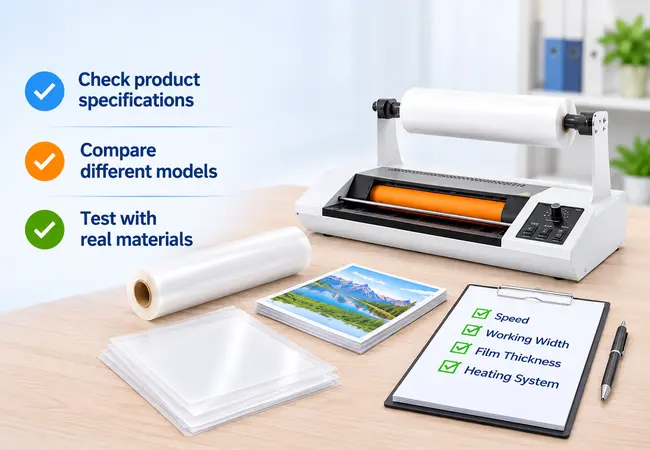
Compare Laminating Machine Specifications
7. Explore Laminating Machines from MECOLOUR
MECOLOUR supplies laminating machines and related office equipment for importers, wholesalers, and distributors.
Buyers can explore the MECOLOUR Laminating Machines and Accessories range to review available models.
When requesting a quotation, provide your target market, preferred working width, film requirements, expected order quantity, and electrical specifications.
Contact MECOLOUR to discuss laminating machine sourcing and wholesale purchasing requirements.
Related:
A4 vs. A3 Laminating Machine: Which Size Is Right for You?
Pouch Laminator vs. Roll Laminator: Key Differences for Buyers
How to Choose a Laminating Machine for Your Business
Best 6 in 1 Laminating Machine for Home Use
Best Laminator Machines for Home and Office Use