


Blog
Pouch Laminator vs. Roll Laminator: Key Differences for Buyers

Pouch laminators and roll laminators both protect printed materials with a laminated surface, but they are designed for different production workflows. For commercial buyers, the main difference is not simply machine size. It is how materials are fed, how laminating film is supplied, and how efficiently the machine handles repeated jobs.
A pouch laminator is generally suited to individual sheets and short production runs, while a roll laminator is better suited to continuous or larger-format work. Understanding these differences helps importers, distributors, and print businesses select equipment that matches actual customer demand.
What Is a Pouch Laminator?
A pouch laminator uses a pre-cut laminating pouch consisting of two connected film layers. The printed document is placed inside the pouch and passed through the machine, where heat and pressure bond the film around the material.
Pouch laminators are commonly used for certificates, identification cards, menus, teaching materials, photographs, and office documents.
Their main advantage is straightforward operation. Users can laminate individual items without preparing a continuous roll of film, making pouch machines practical for businesses with varied, low-volume jobs.
For example, a compact A4 Laminator can be considered for customers who primarily process standard office documents and smaller printed materials.
What Is a Roll Laminator?
A roll laminator feeds laminating film from one or more rolls rather than using individual pre-cut pouches. Depending on the machine design, the film is applied to printed materials through heated or pressure rollers.
Roll laminators are commonly used for posters, printed graphics, display materials, educational charts, and other jobs that benefit from a continuous film supply.
For businesses processing multiple sheets or larger printed formats, a roll-based workflow can reduce the need to load a separate pouch for every item.
However, the exact working width, supported film types, temperature settings, and feeding system depend on the individual model.
Commercial buyers can review MECOLOUR’s Roll-to-Roll Laminating Machine when evaluating roll-fed equipment for their product range.
Pouch Laminator vs. Roll Laminator: Main Differences
| Comparison | Pouch Laminator | Roll Laminator |
|---|---|---|
| Film supply | Individual pre-cut pouches | Continuous film rolls |
| Typical workflow | Sheet-by-sheet processing | Continuous or repeated feeding |
| Common applications | Documents, cards, certificates, menus | Posters, graphics, displays, larger print jobs |
| Job flexibility | Convenient for occasional, varied tasks | Useful for repeated jobs using compatible film |
| Film preparation | Place each item inside a pouch | Load and align the film roll |
| Operator requirements | Generally simple for routine jobs | May require additional film setup and alignment |
| Best suited to | Offices, schools, small print services | Print shops, graphics businesses, production-oriented users |
These are general workflow differences. Actual output quality and production capacity depend on the machine, film, printed substrate, and operating conditions.
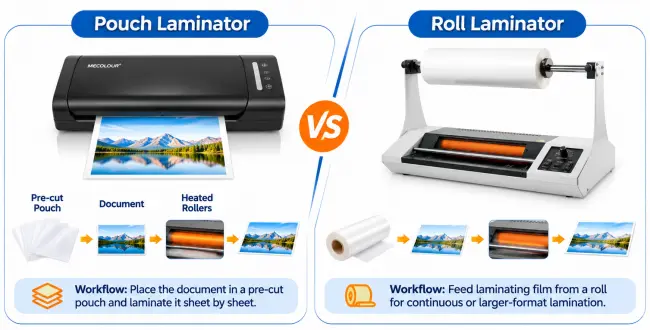
Pouch Laminator vs. Roll Laminator Main Differences
How Does Film Consumption Affect Operating Costs?
Commercial buyers should compare the cost of consumables as well as the purchase price of the machine.
Cost Considerations for Pouch Laminators
Pouch film is purchased in individual sizes and thicknesses. This makes it convenient to estimate the material cost of each laminated document.
However, when a business processes large quantities of similar documents, the cost per pouch and the time required for manual loading can become important.
Cost Considerations for Roll Laminators
Roll film is generally purchased by roll width and length. Its cost per finished item depends on film price, usable width, job layout, trimming waste, and the amount of film consumed during setup.
For repeated production, roll film may offer operational advantages, but savings should not be assumed without calculating actual material usage.
A practical cost comparison should include:
- Machine purchase price
- Compatible film cost
- Film waste during setup and trimming
- Operator handling time
- Maintenance and replacement parts
- Expected monthly production volume
Which Laminator Is Better for Different Business Applications?
Office Supply Distributors
Pouch laminators are often a practical product category for distributors serving offices, schools, stationery retailers, and small businesses.
Customers in these segments commonly need easy operation, compact equipment, and convenient film sizes.
Commercial Print Shops
Print shops handling posters, menus, promotional materials, and larger printed graphics may benefit from roll laminators, particularly when production involves repeated jobs.
Before purchasing, buyers should confirm the maximum working width and compatibility with the film and print media used by their customers.
Equipment Importers and Wholesalers
Importers may choose to carry both machine types because they serve different customer groups.
A product range combining compact pouch laminators and selected roll laminators can address both office-document applications and more specialized printing requirements.
The right product mix depends on local market demand, selling prices, after-sales capabilities, and the availability of compatible consumables.
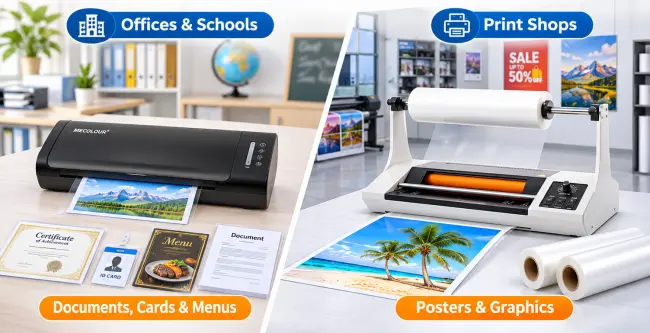
Pouch Laminator vs. Roll Laminator
What Should Buyers Check Before Placing a Bulk Order?
Machine specifications should be verified before comparing quotations from different suppliers.
- Working width: Confirm the maximum material width supported by the machine.
- Film compatibility: Check supported pouch thicknesses or roll film specifications.
- Heating method: Verify whether the machine supports thermal lamination, cold lamination, or both.
- Production speed: Compare actual operating speed under similar test conditions.
- Power requirements: Confirm voltage and plug compatibility for the destination market.
- Film loading: Evaluate setup convenience and alignment requirements.
- After-sales support: Ask about operating instructions, spare parts, and warranty terms.
For distributors, testing the equipment with representative customer materials is more useful than relying on specifications alone.
Can Pouch and Roll Laminators Be Sold Together?
Yes. The two machine types are complementary rather than direct substitutes in every application.
A distributor supplying office equipment may prioritize pouch laminators, while a distributor serving print shops may need roll laminating machines. Businesses serving both markets can evaluate a combined product range.
For wholesalers, this also creates opportunities to supply compatible laminating films alongside the machines, provided the film specifications are clearly matched to each model.
Explore Laminating Machines from MECOLOUR
MECOLOUR supplies laminating machines and related office equipment for commercial buyers, importers, and distributors.
Buyers can explore the MECOLOUR laminating machine and accessories range to compare available models and discuss their purchasing requirements.
When requesting a quotation, include your target market, preferred machine type, expected order quantity, and required electrical specifications. This helps the supplier recommend suitable models and provide more relevant purchasing information.
Contact MECOLOUR to discuss wholesale laminating machines and equipment sourcing for your business.
Related:
A4 vs. A3 Laminating Machine: Which Size Is Right for You?
How to Choose a Laminating Machine for Your Business